
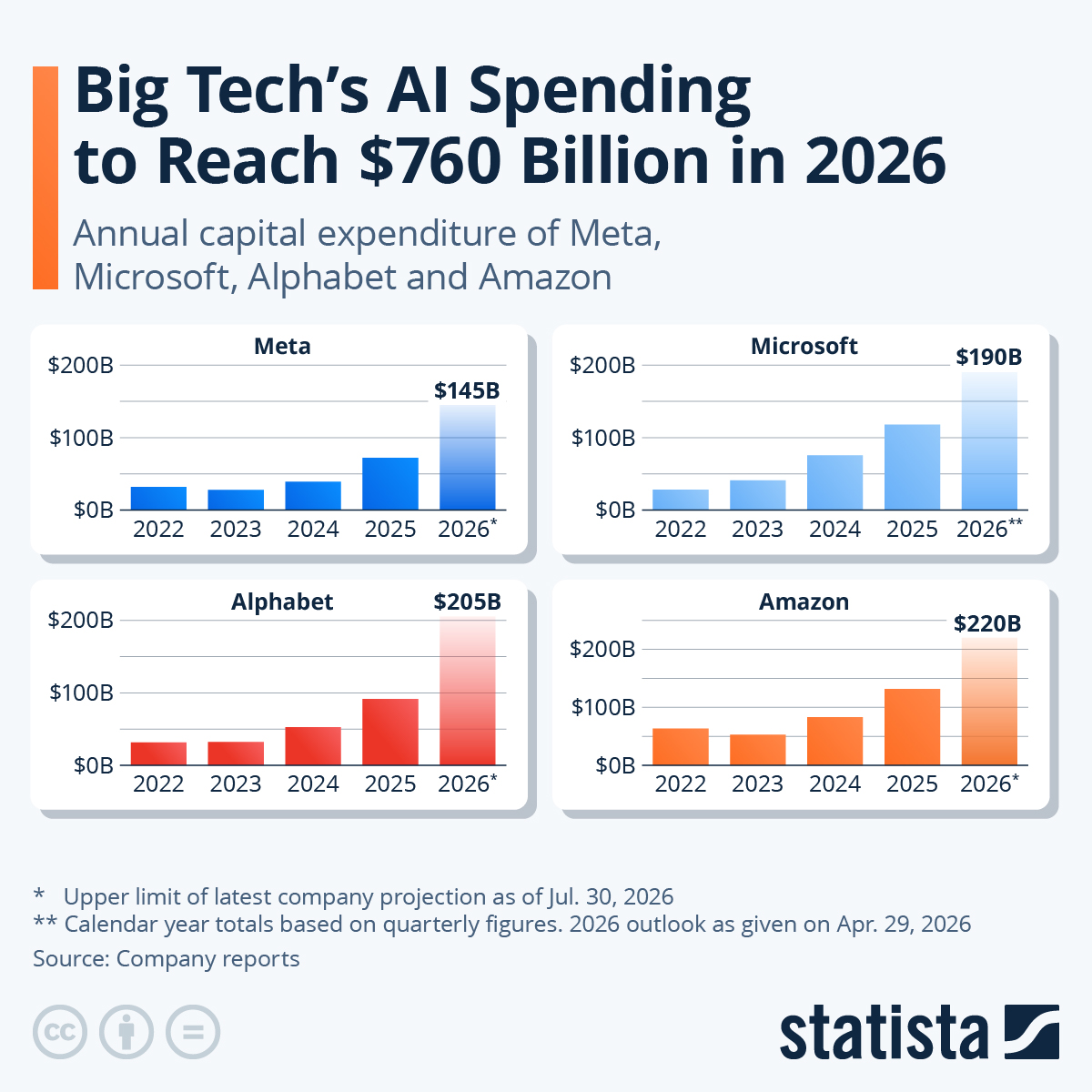
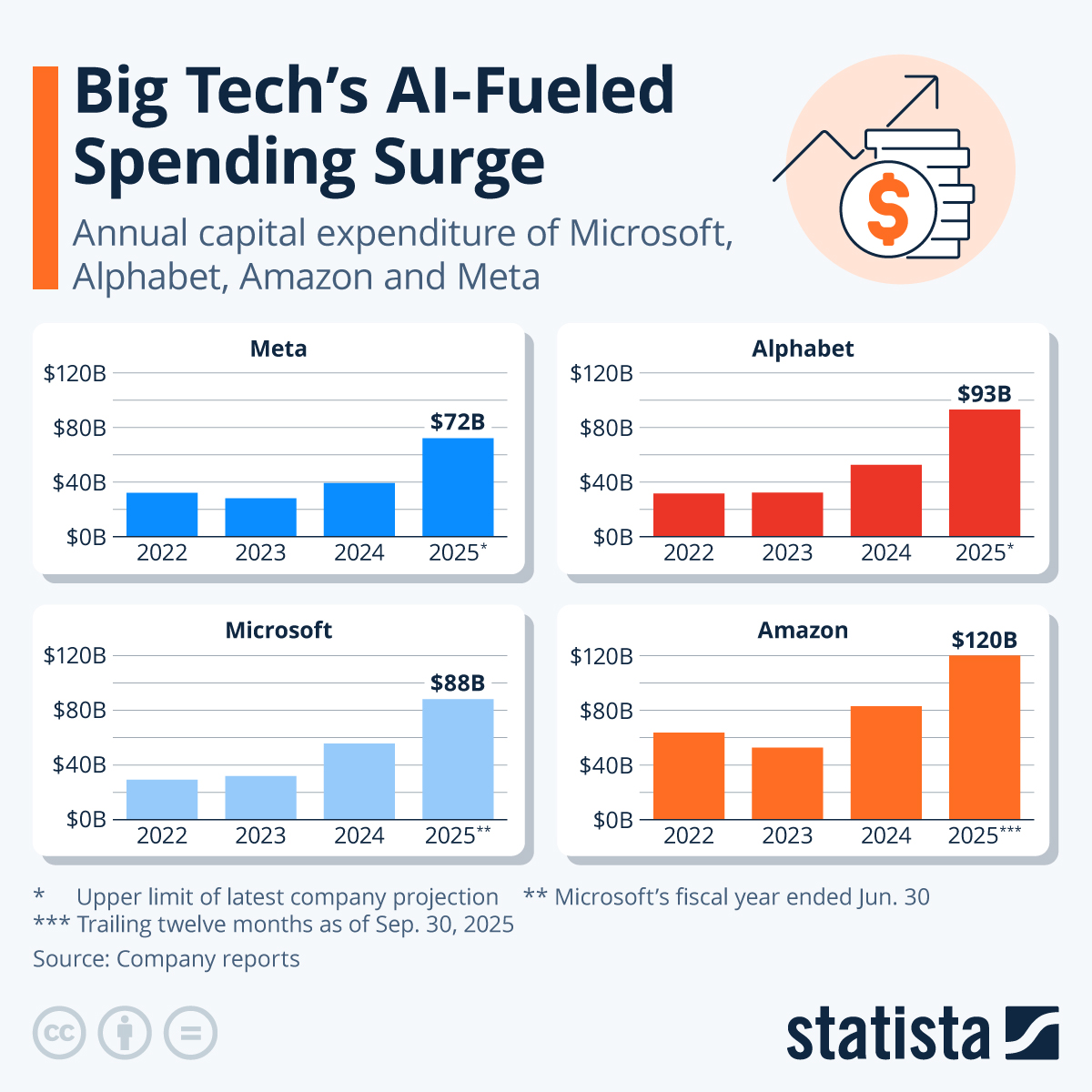
Microsoft, Alphabet, Meta, and Amazon plan to pour $760 billion into capital expenditures this year, according to a report published this week by Statista. That's nearly double the $413 billion these four tech giants spent in 2025. All four companies, which released second-quarter 2026 earnings this week, signaled they'll keep ramping up investments in AI infrastructure, including data centers, chips, and networking gear.
The spending increases aren't just about buying more equipment — rising chip prices are also driving costs higher. Microsoft alone is expected to spend roughly $25 billion in 2026 just to cover elevated chip prices, according to the report. Amazon and Alphabet both raised their capital expenditure forecasts for 2026 during their earnings announcements, as did Meta, though only on the lower end of its range. Microsoft stuck with its April projection of $190 billion. Meta increased the floor of its spending estimate from $125 billion to $130 billion, up from an original range of $125 billion to $145 billion.
 You will find more infographics at Statista
The massive spending is already paying off for some companies. Amazon Web Services revenue jumped 37 percent year-over-year, the fastest growth rate in 18 quarters, while the AI business within Web Services and chips showed triple-digit growth, reaching an annualized revenue of $25 billion, the report states. Microsoft's AI business grew 123 percent year-over-year, while Alphabet's cloud business expanded 82 percent. All three companies posted gains in both revenue and profit. Meta, however, saw profits decline in the second quarter due to legal expenses and severance costs, though revenue still increased.
Investor reactions to the spending announcements were mixed. Amazon's stock price climbed despite the company announcing higher capital expenditures, and Microsoft's shares also rose after it kept its guidance unchanged since April. Alphabet and Meta, both of which announced increased investment plans, saw their stock prices fall. The report notes that some of the depreciation costs tied to these large capital expenditures won't hit profits until next year, meaning the full financial impact is still ahead.
Despite some investor concerns about the scale of spending, company leaders remain confident in their strategy. Amazon CEO Andy Jassy recently described AI as "a once-in-a-lifetime opportunity where the current growth is unprecedented and the future growth even bigger," according to the report. He wrote in his annual shareholder letter that Amazon won't be conservative in its approach, instead investing to become "the meaningful leader," with the expectation that future business, operating income, and free cash flow will be much larger as a result. While some investors are spooked by the sheer magnitude of the investments, the hyperscalers are betting that early, aggressive spending will cement their positions in what they view as a transformative technology shift. The question for executives is no longer whether to invest heavily in AI infrastructure, but whether spending at this pace can continue to deliver returns that justify the outlay before depreciation costs and competitive pressures reshape the landscape.