Software Developer Job Postings Fall 71% Since Peak, Indeed Data Shows
Software developer job postings fell 71% from their 2022 peak to mid-2026, Indeed data shows, reflecting sharp tech hiring pullback after pandemic boom years.
By Justin WoodsWednesday, August 12, 2026
Illustrative image only — not an actual photo of the events or people described in this article.
Software developer job postings in the United States have collapsed from their pandemic-era highs, according to data published by Indeed and archived by the Federal Reserve Bank of St. Louis. The seasonally adjusted index, which measures postings relative to a February 1, 2020 baseline of 100, shows the occupation has experienced one of the most dramatic hiring contractions of any professional field tracked during this period. The data reveals a sustained reversal in demand for software talent following the explosive growth seen in 2021 and early 2022.
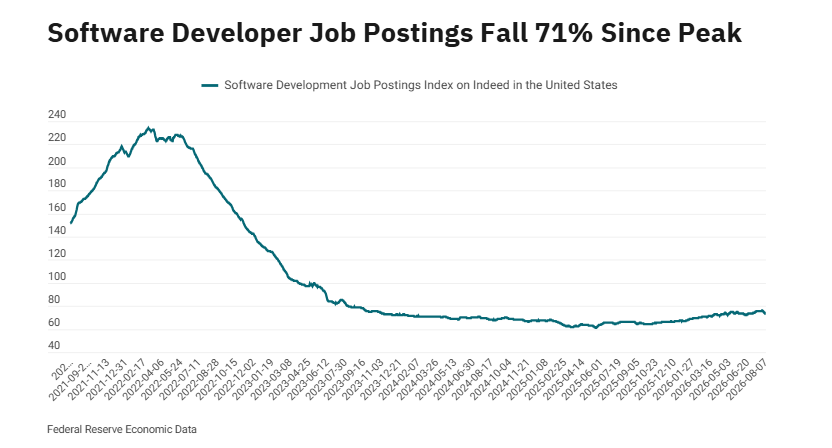
Software development job postings surged to more than double the pre-pandemic baseline by early 2022, then plunged by nearly three-quarters over the following three years before beginning a modest recovery in 2025.
The index reached its highest point at 233.86 on February 28, 2022, more than doubling the pre-pandemic baseline, according to the data. From that peak, postings fell steadily and steeply, dropping to 61.13 by May 17, 2025—a decline of 172.73 index points, or roughly 74% from the maximum. By August 7, 2026, the latest observation in the dataset, the index stood at 73.66, still 26% below the February 2020 baseline and 68% below the 2022 summit. The descent was particularly sharp between mid-2022 and mid-2023, when the index shed more than half its value in just over twelve months. Throughout 2023, postings continued to slide, bottoming out in the low-to-mid 60s during 2024 and 2025. A modest rebound began in early 2025, with the index climbing from the low 60s in late winter to the mid-70s by summer 2026, though this recovery represents only a fraction of the ground lost since the 2022 high.
Indeed calculates the index by tracking the change in seasonally adjusted job postings since the pre-pandemic reference date, applying historical seasonal patterns observed in 2017, 2018, and 2019 to each occupational sector independently. The data is reported daily as a seven-day moving average to smooth short-term volatility. Indeed switched to this methodology in December 2022, revising all historical figures accordingly, which means previously published values may differ significantly from those shown in the current series. The organization notes that end users are excluded from any warranty or liability regarding the accuracy of the data and must credit Indeed when sharing or presenting the information externally.
The dramatic swing in software development postings mirrors broader shifts in the technology labor market, according to the report. The explosive hiring activity in 2021 and early 2022 coincided with pandemic-driven digital transformation, historically low interest rates, and surging venture capital investment in tech startups. As macroeconomic conditions tightened—marked by rising interest rates, inflation concerns, and slower economic growth—technology companies pulled back sharply on hiring, triggering widespread layoffs and freezes on new positions. The correction was especially pronounced in software development, where firms had aggressively expanded their engineering teams during the boom. The modest uptick visible from early 2025 onward suggests some stabilization, though demand remains far below both the 2022 peak and the 2020 baseline, indicating that the sector has not returned to its pre-pandemic hiring trajectory. The data underscores how sensitive software employment is to capital conditions and corporate growth expectations, with hiring volatility exceeding that seen in many other professional occupations.
The outlook embedded in the data suggests software job postings may continue their gradual recovery from historic lows, but a return to 2022 levels appears unlikely in the near term given persistent caution among employers and continued economic uncertainty. The trajectory from mid-2025 through mid-2026 shows incremental gains, hinting that the worst of the contraction may have passed, yet the index remains deeply suppressed relative to both its recent peak and the pre-pandemic benchmark. For software professionals and those entering the field, this signals a fundamentally different hiring environment than the one that prevailed during the pandemic boom. Companies that dramatically expanded their engineering rosters now face the challenge of sustaining lean operations while still innovating, a tension that will define the sector's near-term recruitment patterns and shape career prospects for developers navigating a more competitive and selective market. Strategic decisions around workforce planning will hinge on whether firms view the earlier boom as an aberration or a new normal interrupted by temporary turbulence.
Enjoyed This Analysis?
Subscribe to get stories like this delivered to your inbox every week — free, no spam, unsubscribe anytime.