Statista survey data shows free AI chatbots dominate usage across five countries, with paid access lagging significantly, raising questions about monetization as infrastructure spending soars.
By Oliver WhiteWednesday, September 9, 2026
Illustrative image only — not an actual photo of the events or people described in this article.
Free AI chatbots are significantly more popular than paid versions across five major markets, with users showing little willingness to pay for artificial intelligence tools despite widespread experimentation, according to survey data published by Statista Consumer Insights. The findings, based on responses from 3,700 people aged 18 to 64 in each country surveyed between October and November 2025, reveal a persistent gap between AI adoption and monetization. The data raises questions about who's covering the costs of AI infrastructure as billions pour into chips and data centers while most consumer-facing tools remain free.
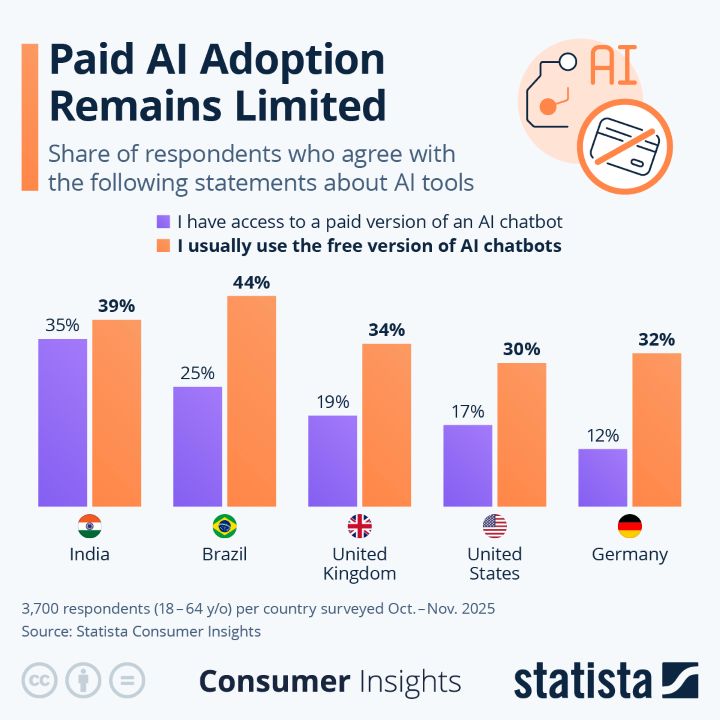
Share of respondents who have access to paid AI chatbots versus those who usually use free versions across five countries, surveyed October-November 2025.
Across all five markets examined, respondents were far more likely to report typically using free AI chatbots than having access to paid versions. In Brazil, 44% of those surveyed said they usually use free AI chatbots, while only 25% reported having access to a paid version—a 19 percentage point gap. The disparity was nearly as large in Germany, where 32% use free versions compared to just 12% with paid access, and in the United States, where 30% use free chatbots versus 17% with paid subscriptions. The United Kingdom showed 34% using free versions against 19% with paid access. India had the smallest gap, with 39% using free chatbots and 35% having paid access, though free usage still led.
The report highlights that the difference is particularly pronounced in Brazil, Germany, and the United States. According to the analysis, many of the most popular AI tools—at least those aimed at consumers—remain free to use to a certain extent. The survey data confirms that widespread experimentation with AI hasn't yet translated into willingness to pay for it.
The report frames these findings against a broader concern about the AI economy's structure. Hyperscalers are investing hundreds of billions of dollars to build AI data centers, driving extraordinary growth for companies like Nvidia, which recently returned to triple-digit growth by doubling both revenue and net income last quarter. But much of this spending appears circular: Nvidia partially invests its earnings in AI companies, which then use that money to rent computing power from the same hyperscalers buying Nvidia's chips. What's absent from this loop is an influx of money from outside sources, or at least a clear picture of where external revenue will eventually come from. With consumer tools staying free and paid adoption lagging far behind free usage, the question of who foots the bill for AI infrastructure becomes more pressing.
The data suggests a fundamental mismatch between the scale of AI investment and current consumer behavior. While companies continue pouring resources into AI development and deployment, users across multiple countries show consistent preference for no-cost options. The low rates of paid chatbot access—ranging from just 12% in Germany to 35% in India—signal that the path from experimentation to monetization remains unclear. Until users demonstrate greater willingness to pay, or until alternative revenue models emerge, the sustainability of massive AI infrastructure spending will remain an open question. The gap between free and paid usage may narrow as AI tools mature and demonstrate clearer value, but for now the economics of consumer AI remain stubbornly circular.
Enjoyed This Analysis?
Subscribe to get stories like this delivered to your inbox every week — free, no spam, unsubscribe anytime.

 You will find more infographics at Statista