The global cybersecurity workforce gap stands at 4.8 million unfilled positions, and it's widening rather than closing, according to a comprehensive workforce analysis published by Index.dev on August 5, 2026. The report, titled "The New Tech Workforce: 10 Roles in Highest Demand Over the Next 10 Years," finds that the fastest-growing tech jobs aren't just emerging from AI but are being created by a broader shift toward automation, cybersecurity, intelligent systems, and data-driven decision making. The World Economic Forum estimates roughly 170 million new jobs will be created this decade by global macro trends, with about 39% of workers' core skills expected to change by 2030 as employers adopt technologies like generative AI.

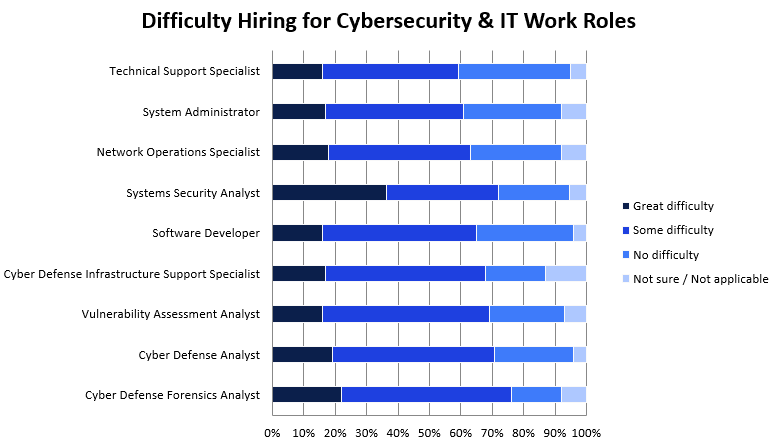
Percentage of employers reporting difficulty hiring for nine identified tech work roles, with Systems Security Analysts showing the highest rate of great difficulty at 47%.
CompTIA's State of the Tech Workforce finds tech employment growing at about twice the overall rate, with a 7% replacement rate each year and total turnover near 37%. Demand for cybersecurity analysts and engineers is outpacing national job growth by 346%, while data scientists and analysts face projected demand growth of 420% over the national average. The U.S. Bureau of Labor Statistics projects data scientist employment growth of 34% from 2024 to 2034, with roughly 23,400 new openings per year on average. Machine learning now appears in 69% of data scientist job postings, and demand for natural language processing skills jumped from 5% to 19% in a single year. The report also highlights that 2.1 million manufacturing positions could go unfilled by 2030 due to labor shortages, driving robotics automation demand, while the global synthetic biology market is projected to balloon from $25.6 billion to $239.3 billion over the next decade at a 25% compound annual growth rate. IDC projects that more than 90% of organizations will face IT skills shortages by 2026, at an estimated cost of $5.5 trillion. Employer surveys reveal severe hiring friction across technical roles, with 47% of organizations reporting great difficulty hiring systems security analysts, the highest pain point among nine identified work roles.
The report identifies what it calls the "AI Paradox": while teams write code exponentially faster using AI tools, 76% of engineering professionals find that more compliance and security issues are discovered after deployment rather than during development, according to GitLab's global Intelligent Software Development Era report cited in the analysis. Productboard's CPO Survey found that 85% of product leaders are actively investing in AI tools, yet only 2% are prioritizing talent development to support it. The report notes that in 2025 alone, 29% of companies paused or restructured their AI recruitment tools due to bias findings. AI governance has become a top-five priority for nearly half of all organizations, yet only 1.5% say they're satisfied with current staffing levels in this area. According to talent director Mihai Golovatenco, who authored the report, 37% of IT leaders report a lack of DevSecOps skills as the top technical gap on their teams, while only 40% of North American organizations currently have a data privacy officer despite expanding regulatory requirements.
The talent shortage is structural and driven by four converging forces, the report explains. First, AI isn't replacing tech workers wholesale but is fundamentally changing what they're expected to do, killing off repetitive work and creating urgent demand for people who can build, train, deploy, and govern AI systems. Second, the cyberthreat surface keeps expanding as bad actors use generative AI to execute highly automated, lightning-fast attacks, forcing a transition toward specialized architects who use predictive AI to continuously harden networks. Third, companies are demanding immediate business value from data pipelines, triggering a massive push toward Domain-Specific Language Models trained on specialized, proprietary datasets for industries like healthcare and logistics. Fourth, automation has shifted from basic scripts to autonomous AI agents that co-create, test, and self-correct software workflows, exponentially multiplying what a single engineer must manage. The skills mismatch is particularly acute because AI has introduced new vulnerability categories—roughly one in four AI-generated code samples contains at least one confirmed vulnerability when tested without security-specific prompts. The talent pipeline hasn't caught up to these demands because the disciplines are relatively new, and training programs lag behind industry needs by years.
The report argues that companies can't afford to lose months trying to find and vet specialized engineers in this environment. Organizations are shifting from traditional hiring toward more flexible access to expertise, focusing less on filling roles one by one and more on assembling the right skills when needed across engineering, data, AI, and security layers. The ten roles spotlighted—cybersecurity analyst, data scientist, AI product manager, data annotator, data privacy officer, DevSecOps engineer, AI ethics and bias specialist, robotics engineer, systems administrator, and bio-digital software engineer—sit at the intersection of all four macro forces and represent what the report calls "highly specialized architects" rather than generalist engineers. The next decade of technology, the analysis concludes, will be defined not by cloud migration or data aggregation but by the race for algorithmic optimization and system autonomy, where the margin for error shrinks as the velocity of software delivery skyrockets.