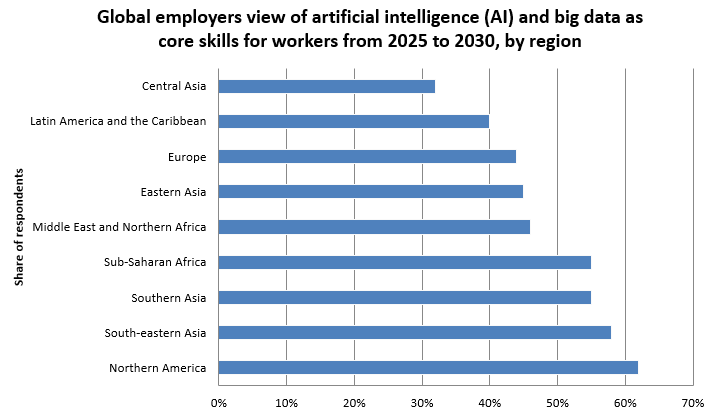
Employers in North America view artificial intelligence and big data as essential worker skills more than anywhere else in the world, with 62% of companies identifying these capabilities as core requirements between 2025 and 2030. What's surprising isn't that wealthy tech hubs dominate this metric—it's that regions like South-eastern Asia and Sub-Saharan Africa aren't far behind. This isn't just about who has the most sophisticated AI infrastructure today; it's about who sees the writing on the wall and is racing to prepare their workforce for an economy where 77% of employers plan to reskill workers specifically to work alongside AI tools.

Employer demand for AI and big data skills varies by just 30 percentage points between the most and least prepared regions globally, with North America leading but developing economies close behind.
The regional breakdown reveals a clear but not overwhelming divide. Northern America leads at 62%, followed closely by South-eastern Asia at 58%, Southern Asia and Sub-Saharan Africa both at 55%, and the Middle East and Northern Africa at 46%. Eastern Asia and Europe sit at 45% and 44% respectively, while Latin America and the Caribbean trail at 40%. Central Asia brings up the rear at just 32%, a full 30 percentage points behind the leader. The gap between the most and least AI-focused regions is significant but not insurmountable—we're looking at a spectrum, not a chasm.
The World Economic Forum's research helps explain why developing regions rank so highly: they're using AI adoption as a leapfrog strategy. According to the WEF's Future of Jobs Report 2025, which surveyed over 1,000 global employers representing 14.1 million workers, 86% of companies expect AI to transform their business by 2030. The report's June 2026 analysis shows that more than one in three young workers globally are employed in roles with medium to high AI exposure—and the stakes are highest in developing economies where productivity gains can dramatically reshape entire sectors. The International Labour Organization warns that unequal access to infrastructure and training could deepen global inequalities, but the data suggests employers in these regions understand the urgency.
The high rankings from South-eastern and Southern Asia make strategic sense when you consider that workers with AI skills now command a 56% wage premium, and 39% of current skills will become outdated by 2030. For developing economies, this isn't an optional upgrade—it's survival. The World Bank's 2026 development report notes that developing countries face a critical choice: adopt existing AI tools, adapt them to local needs, or try to advance the technology themselves. Each path requires different levels of investment and infrastructure. What's holding some regions back isn't employer awareness—it's the lack of digital infrastructure, electricity access, and AI training programs that research shows are prerequisites for AI adoption. A 2024 study found that 84% of interview respondents in developing economies highlighted difficulties in workforce adaptation due to lack of AI-related training. Northern America's lead reflects not just vision, but the infrastructure and education systems already in place to deliver on that vision at scale.
The chart tells a story about the future of work that's less about rich versus poor and more about preparation versus complacency. Employers worldwide recognize that AI literacy is becoming as fundamental as reading or basic computer skills—92% of jobs now require basic digital competency. The regions investing heavily in AI skills training today won't just compete better in five years; they'll define which industries grow and where capital flows. That's why even Central Asia's 32%, while last on this list, still represents nearly a third of employers betting their futures on workers who can harness machine intelligence. The race is on, and nobody's sitting it out.