AI Now Assists 6.3% of American Work Hours as Adoption Accelerates Through 2026
Generative AI now assists 6.27% of U.S. work hours, up 53% since late 2024, with adoption accelerating quarterly among employed adults nationwide.
Saturday, August 8, 2026· By Jason York
Generative artificial intelligence now assists 6.27% of all work hours among employed American adults, up from 4.10% just 18 months earlier, according to new data released by the Federal Reserve Bank of St. Louis on August 4, 2026. The figures, drawn from the Real-Time Population Survey conducted by researchers Alexander Bick, Adam Blandin, and David Deming, show that AI tools like ChatGPT and similar platforms are increasingly integrated into the daily workflow of America's working-age population. The data marks the most comprehensive tracking yet of how much actual work time these tools are handling in the U.S. economy.
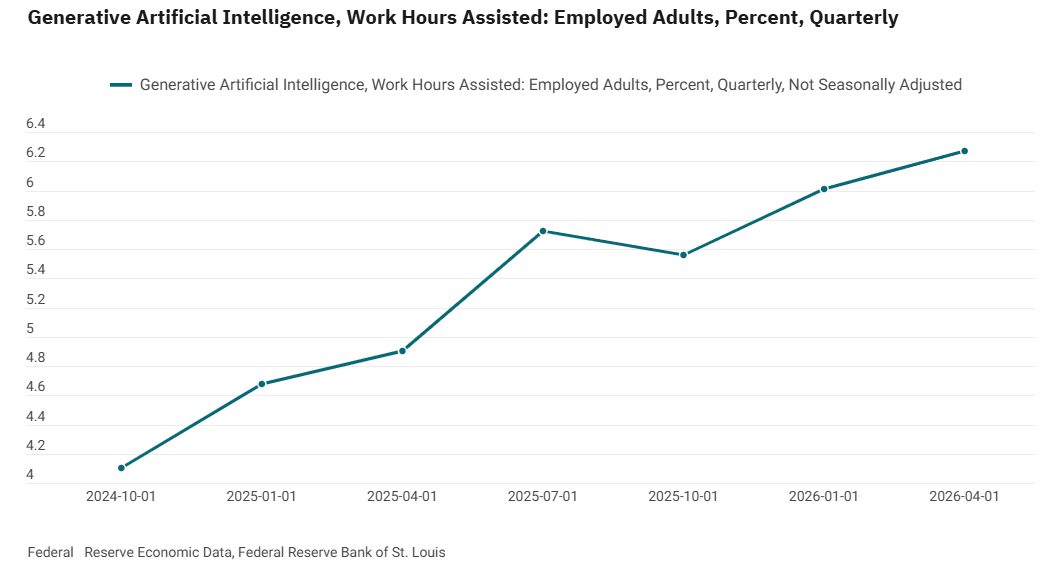
Share of total work hours assisted by generative AI among employed U.S. adults aged 18-64, showing steady growth from 4.1% in Q4 2024 to 6.27% in Q2 2026.
The second quarter of 2026 recorded the highest share of AI-assisted work hours at 6.26688%, up from 6.01118% in the first quarter and 5.56432% in the fourth quarter of 2025. The steepest quarter-over-quarter jump occurred between Q2 2025 and Q3 2025, when the share surged from 4.90247% to 5.72089%—a gain of nearly a full percentage point in just three months. Over the entire tracking period from Q4 2024 through Q2 2026, the share of work hours receiving AI assistance climbed by 2.17 percentage points, representing a 53% increase. The growth hasn't been perfectly linear—Q4 2025 saw a slight dip to 5.56% from the previous quarter's 5.72%—but the overall trajectory shows consistent acceleration in workplace AI adoption among the nation's 18-to-64-year-old workforce.
The researchers calculate assisted hours by surveying employed adults who used generative AI for their jobs in the previous week, asking them how many workdays they used it—one day, more than one, or every workday—and how much time they actively spent using it on those days, with options ranging from less than 15 minutes to more than four hours per day. Because both responses come in brackets rather than exact figures, the data implies both a lower and upper bound on assisted hours when combined with information on days worked and actual hours worked; the published series reports the midpoint between these two bounds. For workers who didn't use generative AI at all, assisted hours are counted as zero. The survey is nationally representative of working-age adults across the United States and comes from research published in Management Science in 2026.
The steady climb in AI-assisted work hours reflects what the authors characterize as "the rapid adoption of generative AI" in the American workplace. Unlike previous workplace technologies that took years or decades to reach meaningful penetration, generative AI tools have moved from novelty to necessity for a growing share of workers in less than two years of widespread availability. The percentage-point gains might seem modest in absolute terms, but they represent millions of work hours nationwide now being performed with AI assistance—hours spent drafting emails, generating code, summarizing documents, analyzing data, or creating content that would previously have required full human attention. The fact that adoption accelerated most sharply in mid-2025 and has continued climbing into 2026 suggests workers and employers are moving past experimental use cases and embedding these tools into core workflows.
If the current pace holds, the data points toward a workplace where one in ten work hours receives AI assistance within the next year, fundamentally reshaping how American businesses operate and how employees spend their time. The Real-Time Population Survey will continue tracking these shifts quarterly, offering the clearest window yet into the speed and scale of AI's integration into the economy. For workers, employers, and policymakers trying to understand the practical impact of the AI revolution, the answer is increasingly clear: it's not coming—it's already here.