AI Adoption Surges to 72% Among Managers as Workplace Tool Use Accelerates
AI adoption among U.S. managers surged to 72% in Q2 2026, up 22 points year-over-year, signaling generative AI's rapid shift to mainstream workplace tool.
Tuesday, August 11, 2026· By Jason York
Nearly three-quarters of managers now use generative artificial intelligence for work, according to new data published by the Federal Reserve Bank of St. Louis on August 4, 2026. The adoption rate among management occupations hit 71.89 percent in the second quarter of 2026, marking a dramatic acceleration in workplace AI use. The data comes from the Real-Time Population Survey (RPS), a nationally representative online labor market survey of working-age adults aged 18-64 in the United States.
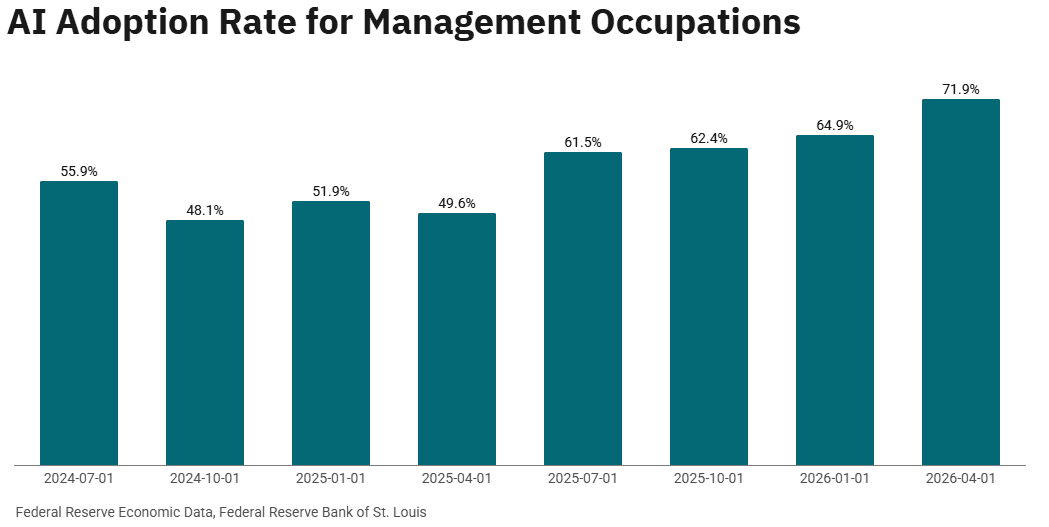
Generative AI adoption rate among management occupations climbed from 55.9% in Q3 2024 to 71.9% in Q2 2026, with sustained acceleration since mid-2025.
The numbers reveal a sharp upward trajectory over the past two years. Adoption stood at 71.89 percent in Q2 2026, up from 64.95 percent in Q1 2026, 62.41 percent in Q4 2025, 61.46 percent in Q3 2025, and 49.59 percent in Q2 2025. That represents a 22-percentage-point jump in just one year, from mid-2025 to mid-2026. The dataset also shows earlier volatility: adoption was 55.9 percent in Q3 2024, dropped to 48.1 percent in Q4 2024, then climbed to 51.9 percent in Q1 2025. Since hitting that low point below 50 percent in early 2025, the trend has been consistently upward, with each quarter showing higher adoption than the last.
The survey asks employed respondents a direct question: "Do you use Generative AI for your job?" and focuses specifically on employed adults aged 18-64 working in Management Occupations. The data is drawn from research by Alexander Bick, Adam Blandin, and David Deming, published in Management Science (2026) under the title "The Rapid Adoption of Generative AI". The authors maintain a dedicated tracker at genaiadoptiontracker.com to monitor these trends in real time.
The rapid climb in adoption rates reflects how quickly generative AI tools have moved from experimental to essential in managerial work. The surge from roughly half to nearly three-quarters of managers in just twelve months suggests that AI has crossed a threshold from early adopter territory into mainstream workplace practice. The volatility seen in late 2024 and early 2025—when adoption dipped below 50 percent—may have represented a period of experimentation and evaluation, after which managers settled into sustained use. The consistent quarterly gains since Q2 2025 indicate that once managers integrate these tools into their workflows, they tend to keep using them, and more colleagues follow suit each quarter.
With adoption now above 70 percent and still climbing, generative AI appears poised to become a standard tool in management work, much like email or spreadsheets. The trajectory suggests that within a few more quarters, AI use among managers could approach near-universal levels, fundamentally reshaping how supervisory and administrative work gets done across the American economy.