China Leads Humanoid Robot Funding With $4.4 Billion Investment Through 2026
China invested $4.4 billion in humanoid robotics startups through mid-2026, just ahead of the U.S. at $3 billion, as 2025 alone attracted unprecedented capital exceeding all prior years combined.
By Timothy YoungMonday, August 17, 2026
Illustrative image only — not an actual photo of the events or people described in this article.
Investment in humanoid robotics startups topped $3 billion in 2025 alone, exceeding the combined total from 2017 through 2024, according to data released by market research platform Tracxn. The surge signals that investors now see humanoid robotics as a more mature and commercially viable technology, marking a turning point for an industry that has long promised practical applications but struggled to attract capital at scale.
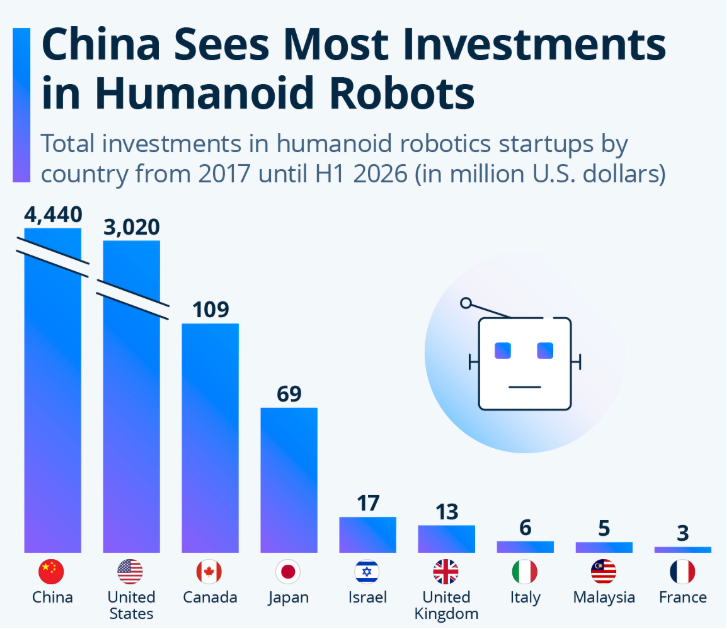
Total investment in humanoid robotics startups by country from 2017 through the first half of 2026, measured in millions of U.S. dollars.
China commands the field with $4.4 billion directed toward humanoid robotics ventures between 2017 and the first half of 2026, narrowly surpassing the United States, which attracted roughly $3 billion during the same window. The two nations form the clear epicenters for humanoid robotics entrepreneurship, with a second tier emerging behind them. Canada leads that group with $109 million invested, followed by Japan at $69 million, Israel with $17 million, and the United Kingdom at $13 million. Italy, Malaysia, and France trail with single-digit millions, suggesting that while curiosity spans the globe, the startup ecosystem remains tightly concentrated in a small number of markets.
Chinese firms Unitree Robotics and Agibot each manufactured more than 5,000 humanoid robot models in 2025, outpacing production from any other country worldwide, the report states. Meanwhile, prominent American companies including Boston Dynamics and Tesla plan to scale up production of robots designed for industrial and consumer use in 2026, with their Atlas and Optimus models respectively. A recent article in the scientific journal Nature described humanoid robots as standing on the edge of commercial utility, noting that mass production is anticipated and current machines can already handle repetitive manual work such as hoisting heavy objects to support manufacturing operations or organizing packages.
The shift reflects what the report characterizes as growing confidence in the technology's readiness for real-world deployment. In industrial settings, humanoid robots have demonstrated capability in performing routine physical tasks that reduce strain on human workers. Within private residences, they've mastered basic activities like pulling doors open, retrieving items, and flipping light switches on and off. The concentration of capital in China and the United States stems from both nations' robust startup ecosystems and established manufacturing infrastructure, which allows companies to move rapidly from prototype to production. European participants include Engineered Arts in the United Kingdom and Neura Robotics in Germany, though they operate on a smaller scale compared to their Asian and American counterparts. The technology's maturation means investors are no longer betting solely on future potential but on near-term revenue from commercial deployment. For businesses weighing automation strategies, the question is shifting from whether humanoid robots will work to how quickly they can be integrated into existing operations and what competitive advantage early adoption might deliver.
Enjoyed This Analysis?
Subscribe to get stories like this delivered to your inbox every week — free, no spam, unsubscribe anytime.